There’s talk of space datacenters lately again, which is an immensely stupid idea. It is stupid because it is a physics and thermodynamics problem, not an engineering challenge. In this post, I will prove why space datacenters will never happen. Not now, not in ten years, not in a hundred years. While we have gotten far in space exploration technology, further than anyone decades ago thought, and while we have had great success in some aspects, such as the International Space Station, people are not computers (shocking, I know), and computers represent an entirely different set of constraints and problems.
Among the space datacenter proponents, you will find the usual suspects: Sam Altman, Elon Musk, and Jeff Bezos.
- Bezos and Musk Race to Bring Data Centers to Space [archived version]
- Big Tech Dreams of Putting Data Centers in Space [archived version]
- Jeff Bezos wants to move ‘all polluting industry into space to keep Earth clean [archived version]
Let’s review the facts:
Cooling
On Earth, we have two basic methods for cooling. One is radiative, and the other is convection. Convection works on Earth because we have a fluid we call air. Air can be heated and cooled. However, the vacuum of space lacks any fluid to drive convection, leaving only radiative cooling.
Radiative cooling in deep space
The Stefan-Boltzmann law governing radiative cooling works as follows:
$$ P = A \varepsilon \sigma (T_{body}^{4} - T_{environment}^{4}) $$
Where:
- $P$ is the total radiated power in watts ($W$)
- $A$ is the surface area in square metres ($m^2$)
- $\varepsilon$ is the emissivity of the surface (dimensionless $0 \leq \varepsilon \leq 1$), which can be simplified to $1$
- $\sigma$ is the Stefan-Boltzmann constant
- $T_{body}$ is the absolute temperature of the radiating surface in kelvin ($K$)
- $T_{environment}$ is the temperature of the environment in kelvin ($K$) or the background radiation, which is around $2 K$ but can be simplified to $0$
Which leaves us with $ P = A \sigma (T_{body}^{4}) $
A good radiator would have an emissivity of around 80-90%. There are no real surfaces that can emit (convert into infrared radiation) 100% of the power they are fed, but by assuming this, we slightly simplify the equation.
Additionally, as you may have noticed, the environment temperature on Earth is much higher, let’s say $300K$, which corresponds to around 26 degrees Celsius and 80 degrees Fahrenheit. This means that radiative cooling in space achieves better results. In fact, radiative cooling on Earth can be disregarded. More than 80% of the cooling for datacenter equipment comes from convection cooling, which includes heat pumps and water-cooling technologies, as they all ultimately dump heat into the surrounding air.
Now, the Nvidia H200 GPU has a TDP of 700 watts (although this is not scientifically exact, it gives us a thermal budget to work with), and assuming a duty cycle of 80%, we get 560W. Conservatively assuming a datacenter with 4000 H200 GPUs, the total thermal power budget is $4000 \times 560 W = 2,240,000 W$, this is the value for $P$.
Let’s also assume our target is to keep the radiators around 70 degrees Celsius, which is $343K$.
So we get:
$$ 2240000 = A \cdot \sigma \cdot 343^{4} $$
$$ 343^{4} = 13{,}841{,}287{,}201 $$
$$ \text{Using} \ \sigma = 5.670373 \times 10^{-8} \frac{W}{m^2 \cdot K^4} \ \text{(Stefan-Boltzmann constant)}$$
$$ \sigma \times 343^{4} = 5.670373 \times 10^{-8} \times 1.3841287201 \times 10^{10} $$
$$ 7.85 \times 10^{2} \frac{W}{m^2} \rightarrow 785 \frac{W}{m^2} $$
$$ A = \frac{2240000}{785} \approx 2854 \ \text{m}^2 $$
Result: You need approximately $2854 m^2$ of perfect radiator surface area ($\varepsilon = 1$) at 70°C to reject 2.24 MW into deep space.
For scale: that’s a square radiator $\sqrt{2854} \approx 53\text{m} \times 53\text{m}$. It has to be completely flat because, given the lack of convective cooling in Space, introducing ridges would cause it to emit into itself. It also has to face away from the satellite (so it cannot be double-sided), otherwise it would be heating the satellite back.
Also note that due to the simplifications ($\varepsilon=1$, $T_\text{env}=0$), this represents a radiator in deep space (not LEO/GEO where Earthshine adds $\sim200$–$300 \ \frac{W}{m^2}$ of infrared heating), which would yield even less favourable results. We are also assuming a perfectly emissive surface, but the best you can realistically achieve is 95% emissivity, further increasing the size of the radiator surface needed.
This is the most optimistic case, and you still need a radiator bigger than $50\times50 \ \text{m}$ for merely 4,000 GPUs.
Convection cooling on Earth
Let’s apply the same $2,240,000 \ W$ figure to atmospheric convective cooling. For this exercise, we will disregard radiative cooling, because the vast majority of heat is carried away by fans and HVAC in a real datacenter.
Newton’s Law of Cooling (convective cooling):
$$P = h \times A \times (T_{body} - T_{air})$$
Where:
- $h$: convective heat transfer coefficient ($\frac{W}{m^2} K$)
- $A$: heatsink surface area ($m^2$)
- $T_{body}$: heatsink temperature ($K$)
- $T_{air}$: datacenter ambient air ($K$)
Heat transfer coefficient
Calculating $h$ is difficult, because it depends on fluid dynamics and the radiator’s geometry. For more information, I recommend visiting the Wikipedia page on heat transfer coefficient because it can get incredibly complex. This tool can also help calculate the values. On this page, we can see:
Forced Convection - air, gases, and dry vapors: 10 - 1000 (W/(m2K))
“Forced convection” refers to convection cooling assisted with fans. The figure can reach hundreds, or even 1000, but in this case, we would be talking about very high-speed jets (airplane jet engines). A typical situation with electronics equipment, and radiators with fins can see figures between 50 and 200.
For this analysis, we therefore choose a conservative forced-convection value of $ h = 50 \text{W/m}^2\text{K}$, comfortably within the typical (low) range for air-cooled electronics.
Let’s plug in some values:
- $T_{body} = 343 \text{K}$ (70°C, same as the previous radiative cooling value, for a fair comparison)
- $T_{air} = 293 \text{K}$ (20°C, standard datacenter inlet)
- $\Delta T = 50 \text{K}$
Given these values, let’s calculate the radiator size.
$$ 2240000 = 50 \times A \times 50 $$
$$ 2240000 = 2500 \times A $$
$$ \frac{2240000}{2500} = A $$
$$ A = 896 m^2 $$
Result: $896m^2$ While still a lot, $ 896 m^2$ is $\sqrt{896} \approx 30 \times 30 \ m$.
30 metres by 30 metres is much smaller than 53 by 53 (or $2854 m^2$) compared to the radiative-cooling situation. But it can be improved even more. This $ 896 m^2 $ is about the total area. In forced convection, using fans, this surface can be made out of fins, as is usually the case with computer heatsinks, further reducing the necessary surface area by making it three-dimensional. And remember I chose a conservative value of 50 for our $h$. In a real datacenter, the value could be 150 or more, which would make it $ \frac{2240000}{7500} = 298.6 \ m^2 \rightarrow \sqrt{298} \approx 17 \ m $, basically a bit more than half the size on each side.
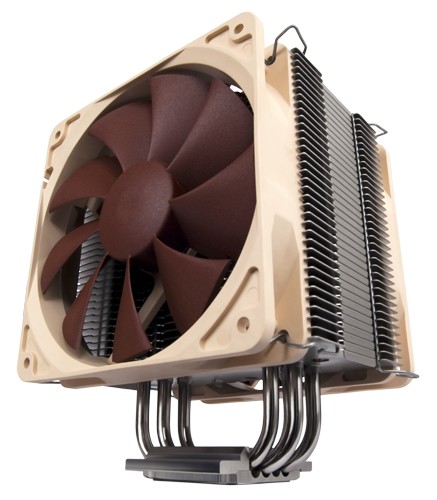
This CPU heatsink is approximately $0.6m^2$. GPUs have much larger heatsinks.
Additionally, this does not account for heatpump-assisted cooling (air conditioning) that many datacenters have, further decreasing the inlet temperature and improving the thermal performance of convection cooling.
Hardware failure in orbit, replacement, and logistics: Astronaut DCOEs
When a GPU fails on Earth, you unplug it, remove it, ship it back to the manufacturer, and slot in a known-good replacement. This is routine work, often done by relatively junior technicians. Downtime is measured in minutes or hours.
Now try to imagine the same operation in orbit.
Once hardware starts failing in a space-based data center, you’re left with three broad options, none of them good.
The first option is to keep human technicians aboard the data center at all times, with rotating crews and life-support systems, much like the ISS. This immediately explodes both cost and complexity. Humans require air, water, food, radiation shielding, escape systems, medical contingencies, and regular crew rotation. At that point, your data center is no longer a piece of infrastructure; it’s a permanently crewed space station, with operating costs that eclipse any plausible energy or financial savings compared to an Earth datacenter.
The second option is to rely on ad-hoc repair missions: keep replacement hardware on the ground and launch a rocket whenever something breaks. This means long lead times, expensive launches, and accepting that even minor failures can take weeks or months to address. Each repair flight costs orders of magnitude more than the hardware being replaced, and the data center continues operating in a degraded state while you wait.
The third option is to do nothing. Failed hardware is written off as lost, capacity permanently decreases, and redundancy slowly turns into dead mass. Every failure pushes the system further away from break-even and shortens its useful economic life and its redundancy capabilities.
On Earth, you can swap out a malfunctioning GPU in minutes, with little to no training, and for $200-$300.
In space?
- Falcon 9 in 2025 costs around $69M.
- SpaceX Dragon 2 seat price is around $55M per seat.
- An ISS mission costs around $60M per seat.
- An astronaut’s salary for a 1-week mission would be several tens of thousands of dollars, but irrelevant next to the amounts listed above.
- Insurance can be about 10% of the total cost.
- Operation costs (regulatory compliance, permits, paperwork, etc) could be around $10M.
We are talking about a $ 69+55+60+10 = 194 $ million dollars before insurance. With insurance, it’s around $ 213M. Just to replace one GPU. If you instead replace 8 GPUs, it is $31M per GPU. Still absolutely unfeasible. Nothing adds up.
Efficiency of solar panels in space
The Earth’s atmosphere is thick, and atmospheric phenomena can occur occasionally, including rain, clouds, and, of course, the day/night cycle, all of which would affect the solar panel, significantly decreasing its performance. A space datacenter could be positioned in such a way that always faces the sun; however, it can’t orbit the Earth, because at some point, it would be covered by the Earth’s shadow.
An orbital datacenter scenario would look like this:
- About 36% more performance per equivalent area compared to direct sunlight on Earth (however, there are no clouds in space, so you always have full power output when light shines on the panels).
- In LEO, you lose roughly 1/3rd of each orbit to eclipse, essentially negating the benefits from the previous point.
- High temperatures hurt PV output, so cooling must be added to the panels. This is a big problem, since the panels should face the sun and be away from the station; if the radiators point back to the station, they would heat it up.
- Finally, since there are no power grids in space, batteries would have to be added to the station so it continues to operate during the eclipse, which not only increases the weight of the launch mission but also significantly increases every imaginable risk. Lead acid batteries can be damaged, and spray acid onto everything, destroying very expensive equipment, whereas lithium ion batteries can cause fires (unless, I suppose, there’s no air inside the space datacenter), but regardless, if a lithium ion battery fails, it will no longer hold a charge, and the datacenter will shut down for 30 minutes every 100.
The only real benefit of space solar panels is the absence of night and clouds, but the increased PV output is offset by orbital eclipses.
Bit-flipping cosmic rays
Cosmic rays are extremely high-energy particles (not radiation, despite their unintuitive name) that can cause electronics to malfunction or even be damaged.
It’s easy to underestimate because nothing visibly hits the hardware, nothing gets hot, and nothing explodes. Instead, bits flip, logic misbehaves, and silicon quietly degrades over time.
On Earth, most cosmic rays are deflected by Earth’s magnetic field, and many of the rest are absorbed by our thick, dense atmosphere. Deep space does not have such a luxury.
They still happen, though. Even on Earth, large fleets at scale see memory errors often enough that ECC is standard in expensive equipment. Cosmic rays are one of the reasons.
How cosmic rays break computers
Cosmic rays can cause “bit-flips”, turning 0 into 1, or 1 into 0 (this is called a “Single-Event Upset”), but they can cause short circuits (Single-Event Latchups), or even energise parts of a circuit board in unexpected ways, destroying traces or transistor gates.
Space-grade systems like the ISS, Mars rovers, and lunar landers are explicitly designed to tolerate these failure modes. They use extensive redundancy (often triple-modular redundancy with voting), aggressive error detection and correction, and continuous memory scrubbing to prevent silent corruption. Critical components are shielded with thick metallic enclosures, and the underlying silicon is manufactured using conservative, well-studied processes.
As a result, space-qualified chips are intentionally several lithographic generations behind commercial hardware. Cutting-edge processors prioritise density, performance, and power efficiency; space hardware prioritises predictability, validation, and survivability.
Mitigation strategies and their costs
Cosmic ray mitigation is a well-established discipline in space engineering. Some techniques include:
- Shielding (mass, making launch more expensive for an equivalent computing power)
- ECC everywhere (complex and costly)
- Checkpoint/restart (performance loss)
- Redundant execution (more compute, more heat)
- Triple modular redundancy (3x hardware, massively increasing infrastructure costs, and leading to potential underutilisation)
- Scrubbing and verification (more power and compute invested into this that isn’t doing any actual work)
Every mitigation increases one or more aspects that space systems can least afford: mass, power draw, thermal load, and system complexity. None of this is necessary on Earth, so at this point, by adding mitigations, we are negating the advantages of space datacenters even further.
Launch costs
Let’s crank some numbers.
- 4000 GPU datacenter.
- 500 nodes (each node holds 8 GPUs).
- Node mass (loaded) around 90 kg (Supermicro HGX 8U is listed at 75.3 kg).
- Packing density: 4 x 8U nodes per rack.
- Rack mass (empty): 140 kg.
- We need 125 racks to hold 500 nodes.
$$ 125 \times 140 + 90 \times 500 = 62500 \ \text{kg} $$
These numbers assume ordinary, Earth-grade datacenter hardware, which is designed for ease of service and airflow rather than mass efficiency. Even then, this estimate ignores large categories of required hardware: networking gear, cabling, power distribution, diagnostics, structural elements, propulsion, altitude control, cooling systems, and solar power.
A bespoke space-grade computer system would likely have different values, but it is not possible to calculate something that doesn’t exist, so I’ll go with this figure.
From Wikipedia:
From 2017 to early 2022, the price has been stated at US$150 million for 63.8 t (141,000 lb) to LEO or 26.7 t (59,000 lb) to GTO (fully expendable).
63.8 metric tons is effectively the same payload class as our 62,500 kg estimate. That means launching just the compute hardware (without power generation, thermal control, structure, or redundancy) already costs on the order of $150 million. That figure is for launch alone, before integration, insurance, failures, or replacement flights.
Conclusion
- A $ 2854 \ m^2 $ radiator with a 1 cm thickness would cost $200,000 just in materials, without accounting for the hinges you need to unfold it in space, the heatpipes to transfer the heat from the GPUs to the radiators, and the engineering required to safely mount it to the side of a satellite, which could make it easily $2M
- 4000 H200 GPUs is 45000 * 4000 = $180M
- Assuming triple redundancy to avoid cosmic-ray bit-flipping, we are talking about 180M * 3 = $540M
- Conservatively assuming two missions for a lifespan of 5 years on the datacenter (very unlikely, as hardware tends to fail more often, especially in space) 213 * 2 = $ 426M
- Launch costs of $150M
The bill is already: 2M + 180M + 540M + 426M + 150M = $1298M. This is $ \frac{1,298,000,000}{4000} = 324,500 $ USD per GPU, and this is an optimistic cost estimation assuming best-case scenarios and ignoring entire categories of logistics, networking, and added complexity.
An enterprise-grade Google 50MW datacenter on Earth with 170,000 servers (significantly more than the 4000 GPU calculation) can cost just $600M, so about $ \frac{600,000,000}{170,000} \approx 3529 $ USD per server (each server can have multiple GPUs). And this is already an extremely expensive datacenter.
So a space datacenter costs more than 100x for seemingly zero benefit, and it can hold several orders of magnitude less GPUs, and will likely have a shorter lifespan (5 years vs practically unlimited for an earth datacenter, with ongoing renovations).
In space, literally everything is more complicated and the increased solar efficiency is cancelled out by the cost and danger of batteries, or the LEO orbit making the datacenter have a duty cycle of 1/3rd.
Space datacenters are not just an engineering problem. No amount of money and resources can offset the fact that space is an incredibly hostile environment for computers.
Yet, experiments show that we can send computers to space. Yes, in very small scales, and for very specific purposes. For example: Computers that can control and correct the position of satellites automatically, or computers that are able to compress pictures and other data so it is quicker and easier to beam them back to Earth. But you won’t be training general-purpose LLMs on satellites anytime in many hundreds or years, or, possibly, ever.